

Ideas don’t move margins, execution does.
Across the last four articles, we’ve uncovered the “Dependency Paradox,” dissected the AI‑driven threat landscape, and outlined the business logic behind Traffic Management 3.0 (TM3.0). Together, these insights trace an industry evolution that now places providers at a decisive crossroads. But recognizing this shift is only the beginning. To capture the value of this new era, providers need technology built expressly for it.
Traffic Management 2.0 (TM2.0) delivered precisely what the industry required at the time: global reach, consistency, and the ability to protect and accelerate digital experiences at scale. TM 3.0 builds on that foundation. It reflects a world where traffic patterns, threat models, and customer expectations are being reshaped by AI, automation, and unprecedented levels of complexity. Providers now need solutions that preserve the strengths of earlier models while enabling greater autonomy, value creation, and differentiation.
This is why we built Blackwall.
The Evolution of Traffic Management
The history of Traffic Management is a transition from static defense to sovereign intelligence:
-
TM 1.0 (Network Traffic): Hardware-centric; the "castle moat" for the local perimeter.
-
TM 2.0 (Network + Cloud Traffic): The era of mass outsourcing to black-box CDNs; convenience at the expense of control.
-
TM 3.0 (Network + Cloud + AI Traffic): The current era. Security is now an adaptive, infrastructure-native capability.
By replacing rigid rules with behavioral AI, TM 3.0 allows providers to reclaim their traffic and transform security from a cost center into a high-margin revenue engine.
Strategic Alignment: Engineering for the Provider
As the industry shifts, providers are seeking tools that meet new security and performance challenges while strengthening their position in the value chain. Traditional models were shaped by centralization. In the AI era, providers increasingly need architectures that scale without relinquishing control over their business-critical asset: their traffic.
Blackwall was designed with these realities at its core. Our mission is clear: ensure that traffic, data, and value creation remain fully aligned with your infrastructure and commercial strategy.
We are a channel-first infrastructure partner. We do not sit between you and your customer; we supply the engine that enhances your existing capabilities. With Blackwall, you maintain total ownership of the customer relationship and the strategic advantage that comes with it. Your brand remains front and center; our role is simply to make it more profitable.
Three Pillars of The Blackwall Solution
To enable true sovereignty, we built our platform on an architecture that prioritizes your business growth:
1. Infrastructure-Native Control: The "black box" era ends when security lives where the traffic begins. Blackwall integrates directly into your existing environment - cPanel, WHMCS, or API-first - as a fully white-labeled solution. This ensures that the value generated strengthens your brand, not a third-party’s. You are no longer reselling someone else’s security; you are providing “Clean Traffic” as a native hosting capability, positioning yourself as the primary point of trust.
The Architecture: Blackwall runs within the hosting provider’s infrastructure as the enforcement layer in the traffic path, evaluating requests before they ever reach customer websites. Protection is managed through panel-integrated workflows and API controls, aligning security configuration with the same operational systems used to provision and manage hosting services. This allows clean traffic to be delivered as a native hosting capability rather than as an externally routed service.
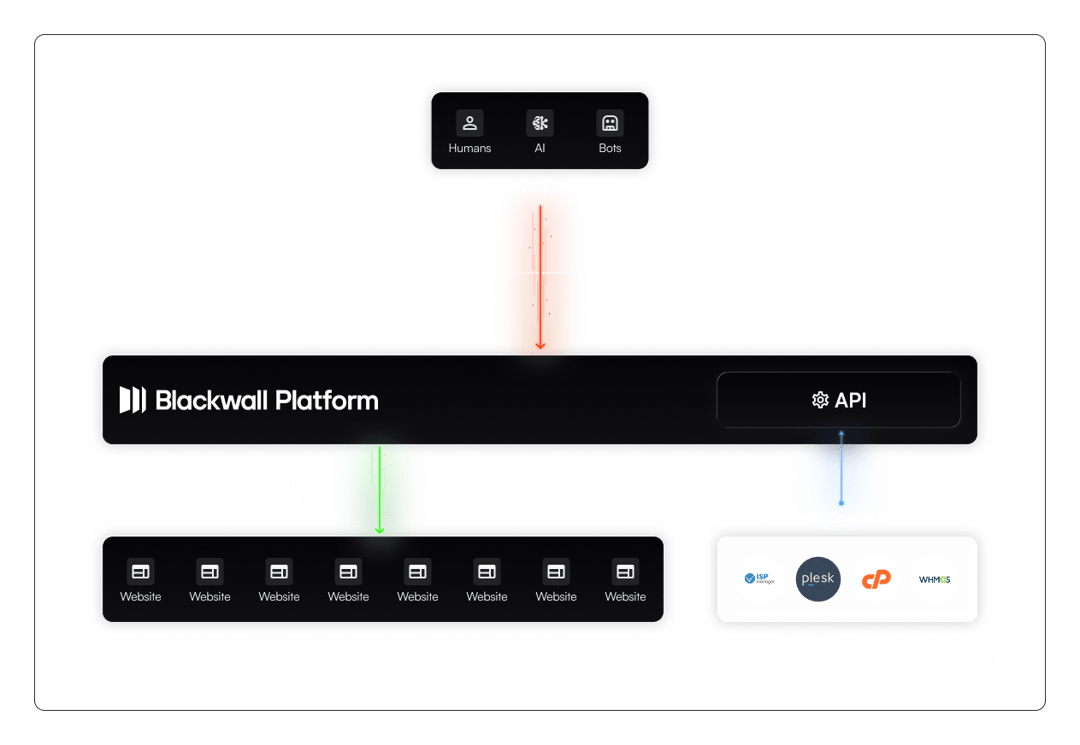
2. Adaptive Intent Analysis: In an era of AI-driven threats, static rules and IP reputation lists are obsolete. Blackwall utilizes real-time behavioral analysis to identify the intent of every request. Whether it is a zero-day probe or a sophisticated scraper targeting WordPress, cPanel, or Plesk, Blackwall identifies the anomaly and blocks the agent before it touches your customer’s application. This is intelligence that lives and learns within your own infrastructure.
The Architecture: Blackwall evaluates request patterns within the context of shared hosting environments, where traffic diversity and multi-tenant behavior require adaptive enforcement rather than rigid signature matching. Decisions are based on observed interaction patterns and behavioral signals, allowing the platform to distinguish automated abuse from legitimate user activity without relying solely on static reputation data. This ensures “Clean Traffic” is maintained consistently across a high-density hosting footprint.
3. Sovereignty at Scale: Our API-first architecture delivers low-latency filtering for millions of sites without requiring a third-party proxy. This is the cornerstone of TM 3.0: you maintain the "Clean Traffic" at your edge. By removing the intermediary, you reclaim data sovereignty and, crucially, retain the margins typically lost to external cloud platforms.
The Architecture: Blackwall scales alongside the hosting provider’s existing infrastructure, supporting high domain counts without introducing an external traffic layer. Because enforcement remains internal within the provider’s own network, traffic handling and service configuration stay fully under the host’s control. This model allows the delivery of high-performance security at scale without the risk, latency, or cost of redirecting customer traffic through third-party platforms.
The Profit Engine is Already Here
The transition to Traffic Management 3.0 is more than a technical upgrade; it is a strategic choice to stop being a reseller of someone else’s security and start being a provider of your own. It makes a shift toward a model where your technology partners support your growth rather than overshadow your brand.
The infrastructure you have built over years, or decades, is full of unmonetized potential.
There is a profit engine waiting to be activated within your servers. Blackwall is simply the key to turning it on.
Exit the Dependency Paradox and Reclaim Your Edge!
More about TM3
Traditional, rule-based defenses are no longer enough. You need visibility into intent, not just traffic patterns.
Smarter traffic handling protects infrastructure, improves user experience, and opens new value for your business.
Security has historically been viewed as a cost center, but it can become a strategic advantage and revenue generator.